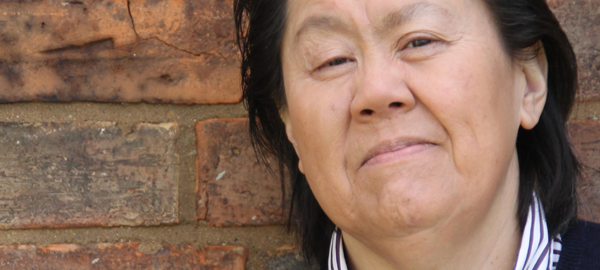
Interview with Kerry Young
Kerry Young is one happy writer. Since the publication of her first novel Pao in 2011, she has been shortlisted for the Costa First Novel Award 2011 and the Commonwealth Book Prize 2012, and has been invited to read at this year’s Calabash literary festival in Jamaica, where she was born.
Of Chinese-Jamaican heritage with a background in youth work, Young is now working on her second novel Gloria for Bloomsbury. She shares her journey, from final draft to the publication of Pao, with Andrea Enisuoh.
How would you describe Pao?
Pao is the story of a 14 year old boy who goes to Jamaica when his father is killed in the civil war in China. He is taken in by Jang, a godfather figure, “the uncle” of China Town. Then Pao rises up to take over.
While Pao is the protagonist there is clearly another story going on here.
Basically the book is a social and political history of Jamaica as seen through the eyes of young Pao. It covers the period from 1938 to the early 1990s at the end of the second Michael Manley administration.
The beauty of this book is that it is literary and yet written in patois. Though born in Jamaica you came to Britain when you were 10 years old. Was it a struggle to maintain that authentic voice?
The book actually didn’t start off in patois. It started off in English. Then one day I was sitting on a veranda back home and Pao just started talking. What he said is now the beginning of the book. When I realised I was going to write it in patois it had already been drafted twice. In a sense Pao knew the story and once he started telling it he didn’t stop until it was done.
As writers we face many challenges. What has been the biggest challenge in your creative journey?
My challenge was that I wanted to write a book of fiction that could be published by a mainstream publisher. I needed to prove to myself that I could do it. Self-publishing wouldn’t have proved that to me. In my heart I wanted a mainstream publisher. I wanted to prove to myself that I was good enough.
Many writers dream of being published by the mainstream. How easy was that for you?
I initially got rejected by every agent in the Writers’ & Artists’ Year book – twice. Looking at it now, being rejected forced me to write a better book every time. After the tears and the thrashing about I would retreat into my little hole and make the book better.
You were eventually taken on Susan Yearwood, one of the only black literary agents in the country. How did that happen?
I joined a black women writers’ group. Someone there told me about a new literary agent called Susan Yearwood who had only been in business six months. They suggested I send her my manuscript. I did and she called and left a message saying “I have just finished reading your book and I want to talk to you”. I was so excited I rang her up and kept asking if she was now my agent. She said she wasn’t and we had a few things to do first. Once we sorted the few things out, Susan took me on and very quickly she had my work under consideration by Chatto & Windus.
Was it really as simple as that?
They sat on it then said they really liked the book but that there were a few problems. They weren’t really clear at first what the problems were. In the end I was having dinner with Susan when we got a text message from Bloomsbury who eventually published the book.
How is it being a writer full time?
It sounds very grand, but I am living on tuppence. My main commitment is working on Gloria, my second novel. People ask you to do all these things but nobody pays you any real money. So you do book clubs, library readings and literature festivals. Everything I now do is connected to writing and it is absolutely fantastic.
[toggle title=”Read an extract from Young’s first novel Pao.”]
1945
Me and the boys was sitting in the shop talking ‘bout how good business was and how we need to go hire up some help and that is when she show up. She just appear in the doorway like she come outta nowhere. She was standing there with the sun shining on her showing off this hat, well it was more a kind of turban, like the Indians wear, only it look ten times better than that. Or maybe it just look ten times better on her.
She got on this blue dress that look like it must sew up with her already inside of it, it so tight, and a pair of high heel shoes I never before seen the like of. I almost feel embarrassed that she come here and find me like this, sitting on a empty orange crate, in my vest with the beer bottle in my hand. So we all three of us quickly jump up and ask her how we can help. And what she want is for me to go visit her sister in the hospital so I can see what some white sailor boy do to her. “What he do to her?” Hampton ask.
“He beat her. He beat her so bad I can hardly recognise her, my own sister.”
“So what he beat her for?”
“Just go see her. That is all I am asking of you.” And then she look directly at me and say, “Can you do that?”
And I just say “Yes” even though I don’t know why.
Then she say, “Thank you” and hand me a piece of paper with the details of the hospital where the sister at. The sister name Marcia Campbell. Then she say, “Marcia will tell you how you can contact me if you decide you want to help.” And she turn and walk outta the shop.
©Copyright Kerry Young 2012 [/toggle]