The Mistress Contract
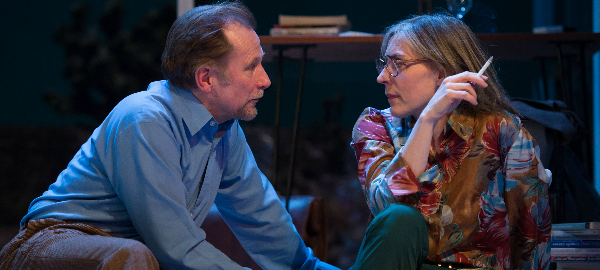
An unconventional arrangement: Danny Webb (He) and Saskia Reeves (She). Photo by Manuel Harlan.
Play: The Mistress Contract
Theatre: Royal Court Theatre
Playwright: Abi Morgan
Director: Vicky Featherstone
Review by Natalie Gormally
Abi Morgan makes her Royal Court debut with an adaptation of The Mistress Contract, the memoir of an anonymous American couple only known as He and She. For over 30 years, He and She have been lovers. Now in their 90s, the couple reflect on their relationship.
They first meet at university, and then lose touch. After 20 years, several marriages and a number of children, they meet again and reignite their affair. She (Saskia Reeves) is a teacher and considers herself at the forefront of the feminist movement. He (Danny Webb) is a wealthy businessman, full of bravado.
Unhappy with their arrangement, She decides to write a contract. In return for her “mistress services” – which she describes as all “sexual acts as requested” – He is to provide her with a home and income. She sees this as a revolutionary act of feminism. He is “delighted to accept”- once he “runs it through his lawyer”. And so the “experiment” (as She refers to it) begins.
The play is based on the real couple’s taped conversations, which take place at home, over dinner and in bed. Morgan chooses to highlight the couple’s exchanges on the issues of sex, gender politics and the role of feminism.
While this set up offers the potential for an explosive relationship, their discussions feel more like She is berating He. It comes across like an impassive debate, academic heavy and too composed considering their unique situation.
The world changes considerably during their time together, but their exchanges fail to reflect this and their lives aren’t influenced by external events. There are only a few brief references, one being the late-1980s recession. “It’s tough out there,” He tells her, like she is locked away in some mistress bubble.
It’s unclear whether either of them cogitate on their situation or have any conflict about their arrangement. How this agreement sits alongside her feminist views is not explored with any depth either. Only in the play’s final 20 minutes, while discussing her mastectomy, do we get a real sense of their relationship and what it bloomed into. “I don’t want other women,” He reveals in a genuinely touching scene.
Reeve and Webb tackle the intense dialogue well and play up some of the couple’s more amusing exchanges, particularly on the topic on fellatio and irrigation systems. Merle Hensel’s set is a striking glass-walled condo, overlooking the Western America desert. Under Vicky Featherstone’s direction we see the characters age neatly throughout the play. Cassette tapes of their conversations begin to accumulate at the front of the stage, representing the passing of time. Yet the set never changes. Maybe Featherstone wants this to represent the couple’s unchanging circumstances.
For a relationship to survive this long – in whatever way – you’d expect more intimacy, lust and passion. Instead, for the majority of the play, it feels transactional and uninvolved – like an “experiment”. But with over 30 years of life together and still going strong, maybe He and She have got it right after all.
The Mistress Contract is at the Royal Court until 22 March 2014.