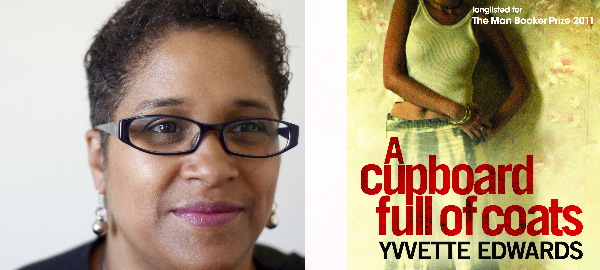
Interview with Yvvette Edwards
Award-winning novelist Yvvette Edwards doesn’t fit the stereotype of a traditional writer. With a varied career covering housing and benefits, the Barnet-born, Hackney-based writer only started to take her career seriously at 40 years old. Her first book, A Cupboard Full of Coats – the story of Jinx whose mother was stabbed to death in their East London home – made a big literary impact and was longlisted for the Man Booker Prize. It went on to garner numerous other nominations, including the Commonwealth Writers’ Prize, the Writers’ Guild Awards, the Hurston-Wright Legacy Award and the Waverton Good Read, and won the Kirkus Best Book of the Year Award.
Edwards’ latest book, The Mother, has just been picked up by Pan Macmillan and looks set to stir up another wave of award nominations. She tells Joy Francis about how the death of Elvis Presley triggered her passion for writing, why there are no white characters in her debut novel, her passion for women’s issues and why her best piece of writing advice came from horror writer Stephen King.
When did you first know you wanted to be a writer as your professional career has taken in working in housing and benefits?
I’ve always enjoyed writing and I’ve written throughout my life. I did my first big piece of work in 1976 when I was ten years old. It was an autobiography of the life of Elvis Presley after he had died. My mother and relatives wailed as if a family member had died so it was a way of working through my grief and trauma. I found the process cathartic. Writing keeps me sane. I can write through my angst, issues and questions. Although I always wrote, I never edited anything and never really committed to a proper writing career and drifted from job to job. On my 40th birthday I gave myself a firm talking to as I hadn’t made any real moves to sort my career out. I had these notions of having a career in writing but I still hadn’t edited anything I wrote. So once I made the decision I wrote a Cupboard Full of Coats while I worked part time. When I finished the book I edited it. I didn’t think I would love editing as it always seemed like it would be a chore, but I do. When I became a published author it became really clear that this was what I always wanted to do.
When you met your agent for the first time she drew your attention to the fact that none of the characters in A Cupboard Full of Coats was white. You were surprised at that revelation. Why?
I drew the characters from my upbringing, my heritage and people that I know around me. It was just natural to write about characters with a Montserratian heritage. I knew the music they would be listening to and food they would be eating. It was an organic process that happened naturally. It was only after I met my agent and she said do you know there is not a single white character in your book that I thought about it. I was stunned as I hadn’t noticed and I thought she had to be wrong. I went through all of my characters thinking, surely there was must be one, but there wasn’t. Jinx, my main character’s world is small so there aren’t that many characters in the novel. I just didn’t think about it.
You’ve said that A Cupboard Full of Coats is a novel that transcends race and politics. Considering the subject matter, domestic violence, how did you navigate that?
I’m very interested in women and women’s issues. I’m kind of perpetually frustrated by sexism and the stereotyping of women that goes on. I was very keen to create a strong female character. I don’t know if I was consciously thinking that I wanted her to defy stereotypes. Women are wonderful and flawed at the same time so I just wanted to create a real woman with real emotions, feelings and depth. And I wanted to talk about domestic violence. I have a million questions on the issue and I’m interested in people’s ideas and opinions and the effects of trauma, in this case how domestic violence impacts on the children who witness it. I wanted to explore the characters involved rather than the violence itself. And I wanted to do it from the perspective of a child who had witnessed it.
You’ve also suggested that the book’s characters, such as Lemon, are like members of your family. How much did you draw on your relatives to shape the characters?
I was very careful. My family is quite large and is filled with lots of eccentric characters, which I love. I was very conscious when I was writing the book that I didn’t want any of my characters to be anyone in my family. When people read your work, as an author you know they will try to see if there is anyone they know or any of themselves in the characters. I didn’t want to put anyone under that scrutiny as I could possibly lose friends that way. I did use aspects of characteristics from people I know in my characters. Lemon’s outlook, sense of humour and ability to talk without any real concern about the impact of his honesty comes from my late grandfather, who was quite an astonishing man.
You have now completed your third novel, The Mother, which will be published by Pan Macmillan. What is the book about?
It is about a 16 year old boy who is stabbed and killed by another 16 year old boy. The book follows the trial of the boy accused of his murder and the narrator is the victim’s mum. A couple of things happened in 2011 that made me interested in young people and violence with the continual stabbings and shootings in the media, week in and week out. I wanted to have a better understanding of where that propensity for violence comes from in young people, and why a 16 year old can so easily write off someone’s life and, in the process, write off their own. Although I knew I wanted to write about a young boy killed by another young boy, I didn’t want a young narrator. I wanted someone in my age group, or older, with the same questions that I have about why a young boy would kill another. What was his upbringing? What shaped him? How did he come with the value system that he has? The mother in my novel has a lot of those questions and throughout the novel and court case she gets to explore them.
What advice do you have for aspiring writers, as you have managed to write three books as a wife, mother and full time working professional?
If you want to write, I’m probably an example of the fact that however little time you have, space can be made to accommodate your writing. Over the years I’ve become an expert in finding pockets of space. While my kids are ice skating, I’m on the side writing on my laptop. I can edit on any type of public transport. If you want to write, you have to be persistent in making the time you have work for you. Persistence is the key. One quote I love that keeps me focused is by Stephen King. He said books on the bookshop shelves are evidence of persistence, not genius. I completely get that. Not every book you read is a masterpiece, but the reason they are in shops and are available for sale is because someone stuck with it. It is also important to write for yourself. Everyone has their own story inside them and you have to write about that; don’t try and tell someone else’s story, or write in a fashion that someone else suggests is the best way to do it. And read. You really need to read.