The Jaipur literary experience
The Jaipur Literature Festival attracts many ‘want-to-be-published’ writers, but the scale of the event is immense. I was among the 245,000 people estimated to have attended the five-day celebration of books and writers, held annually since 2008 in the historic grounds of Diggi Palace.
The massive jamboree, which ended on Sunday 25 January, featured over 300 authors in 170 sessions. I attended the festival for two reasons. Firstly, for www.asianculturevulture.com – a digital magazine I launched which is dedicated to covering the Asian arts scene in Britain. Our main focus at the festival was authors of South Asian origin who are based in Britain.
Secondly, I am also a writer. I had a teenage novel published (some years ago), have a film that is close to production for this year (fingers crossed), and have TV and novel material just waiting to be pitched.
Probably the biggest draw at the festival this year was Sir VS Naipaul. Now 82, the 2001 Nobel Laureate has cut a controversial figure, especially in India. Leaving his native Trinidad in the 1960s for a scholarship at Oxford University, he settled in London and sought to establish himself as a writer.
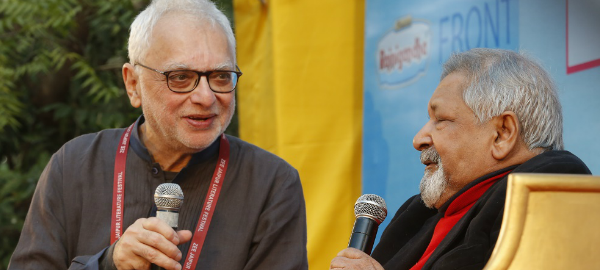
His age and frailty (he is now in wheelchair), meant he was appearing only in one session entitled The Writer and The World. His interlocutor for the talk was the British-based Indian-born writer and critic Farrukh Dhondy (both are pictured above).
While much of the piece I wrote for www.asianculturevulture.com dwelled on the books that Naipaul wrote about India, and formed the substance of his session with Dhondy, little time was available to cover in detail his ambition to be a writer and achieving it.
What he did reveal was that his was not a coherent ambition. He confessed he simply wanted to be a writer, but had no training or qualifications for it. At first, like many, he faced rejection and disappointment. He described having to maintain friendly relations with a publisher, despite being told his early work wasn’t good enough.
Crucially, he said it was important to believe in his own talent, and was doggedly determined in his quest to be published, which eventually happened through Andre Deutsch.
His session was seen and heard by 5,000 people – a staggering number and a reminder that in some parts of our world, writers and their work matter far more than a jolly jaunt to Hay or Cheltenham, where writers of colour are thin on the ground.
In India, Naipaul is viewed as a big irritation. He has been extremely critical, or seemingly so, about the country and its leadership. What struck me about his session was his calmness, his generosity of spirit (not something I thought I would ever say about a man who has dismissed women writers as “not being up to it”).
It seemed to me, in a crude fashion, he had mellowed. Naipaul said he has been misunderstood. He accepted the “misunderstandings” such as they were, and he never once during his talk attacked those who attacked him. Here was a writer who seemed not only at peace with himself, but the world at large.

Sailesh Ram (second from the right) with his production crew at the festival.
As well as Naipaul’s revelatory talk, interviewing seven writers, and broadcasting four of them (Romesh Gunesekera, Farrukh Dhondy, Kamila Shamsie and Anita Anand) in real-time during the festival, was a tremendous highlight.
Interviews with the rather brilliant Eimear McBride, Ashwin Sanghi (who has just penned a crime novel with James Patterson) and Maria Chaudhuri (an emerging multi-national voice) are to follow.
Here’s a little anecdote I’d like to share, which encapsulates the Jaipur experience. While writing the piece on Naipaul on the press terrace, an interview was being conducted by an Indian journalist with an American sounding gentleman. Asked to talk about his background by the Indian journalist, there seemed little that was remarkable until the American said something along the lines, “I was a soldier and I served in the Iraq War”.
A few years back, I’d bought a book by a former soldier who had served in the Iraq War. I knew it had the word “birds” in its title, but I was struggling to recall the name of the author. I could see it on his badge but it still didn’t ring a bell. When he said his first book was called The Yellow Birds, everything fell into place. It had been nominated for a US National Book Award and Kevin Powers had been a highly acclaimed poet before publishing his first novel.
At many festivals, he would be a huge draw, but here, he was just another author promoting his work. Work that had already found its way to me in London and is now seeking an audience in India. That is what literary festivals should be about.
Sailesh Ram is the editor of www.asianculturevulture.com and is a member of the Words of Colour Productions Steering Advisory Committee.
To find out more, visit Twitter @asianculturevul or Facebook .