Dara
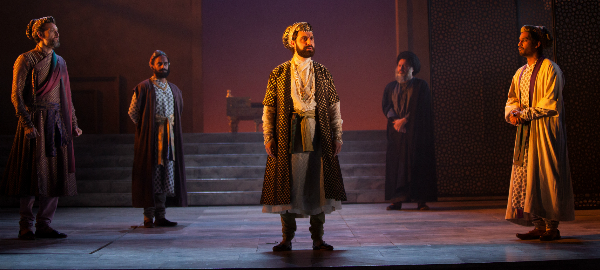
A matter of faith: Nicholas Khan (Mir Khalil), Esh Alladi (Governor Khan), Sargon Yelda (Aurangzeb), Simon Nagra (Mullah Farooq) and Rudi Dharmalingham (Danishmand). Photo credit: Ellie Kurttz
Play: Dara
Theatre: National Theatre (Lyttleton)
Playwright: Adapted by Tanya Ronder from Shahid Nadeem’s play (originally performed by Ajoka Theatre, Pakistan)
Director: Nadia Fall
Review by Natalie Gormally
Dara is the story of two brothers and their rivalry for the head of the Mughal Empire – a dispute that played a key role in shaping the history of modern day India and Pakistan. This epic 17th century tale is well known across South Asia, but it feels like the stuff of Shakespeare and deserves to be better known elsewhere.
At the centre of Tanya Ronder’s reworking of Shahid Nadeem’s play (first seen in Pakistan) is the debate over the nature of Islam and the warring princes’ differing views. Despite being set four centuries ago, the issue still feels topical, and we can see how the repercussions have trickled down to the present day.
Zubin Varla is outstanding as the open minded Prince Dara Shikoh. Dara loves music, poetry and is popular among the people due to his thirst to understand more about all religions. But he is unsuccessful in claiming the Peacock Throne when pitted against his hardline, brutal and power-grabbing brother Aurangzeb (played by the terrific Sargon Yelda).
After Dara is captured, he is paraded through the streets of Delhi on an injured elephant, and made to stand trial for apostasy, in a Sharia court, for translating Hindu religious texts and wearing a crucifix. This lengthy scene is undoubtedly the highlight of the play with Dara delivering a passionate and dignified speech about the teachings of Islam, showing the religion’s take on humanity, knowledge and tolerance.
He makes the case of “Who cares which door you open to come into the light?”, and that the Mughal Empire has flourished, partly due to its acceptance of its colonised people’s varied religions. Yet he knows his appeal will only stoke the hardliners.
Leading up to the second half, the play occasionally feels a little one-sided. But Tanya Ronder’s script goes some way to explain the psychological motivations behind Aurangzeb’s actions, from his relationship with his father to falling in love with Hira Bai, a Hindu girl (Anjana Vasan) as a young man. Hira’s death is a particularly eye-watering scene.
Katrina Lindsay’s set designs beautifully evoke the architecture of the Mughal Empire, the most famous landmark of which is the Taj Mahal built under the direction of the princes’ father, Shah Jahan, who has now been imprisoned by his son. Transitions between the scenes and the progression of time are all aided by tall, sliding latticed screens, while traditional music and mesmerising veiled Indian dancers add a stylish aura to the play.
Ronder has undertaken an ambiguous task of bringing this complex and relatively unheard of tale to a new British audience. A succession of short scenes – moving between the past and present – are to help provide historical context to the story. This approach demands our attention – although it doesn’t completely steer us away from confusion in the first 15 minutes. The script is also peppered with modern colloquialisms – bringing sporadic comic relief and showing that, despite being part of an Empire, the family dramas are much the same.
Director Nadia Fall brings out strong performances from the leads, but also noteworthy are Vincent Ebrahim, as the bias father and Emperor Shah Jahan who appears to be on the periphery of madness, and Scoot Karim as the mystical semi-naked Sufi preacher and Itbar’s (Chook Sibtain) path from child to imperial eunuch.
There is a lot to pack in and Ronder doesn’t skimp on the story. Overall Dara is a fascinating cinematic tale that seeks to educate as well as entertain.
Dara is at the National Theatre (Lyttleton) until Saturday 4 April 2015.