Silver Shores
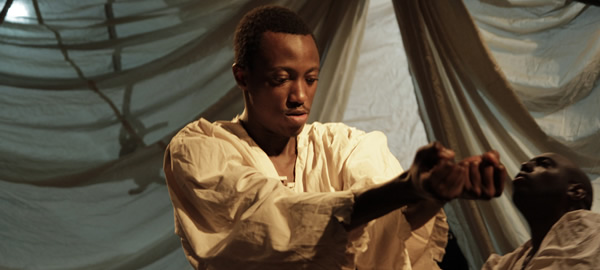
Emmanuel Akintunde as Lekan with Edd Muruako (Villager). Photo by Andrew Alderslade
Play: Silver Shores
Theatre: Tristan Bates Theatre
Playwright: Tian Glasgow
Review by Joy Francis
Slavery is a contentious topic. From Alex Haley’s epic Roots to Steven Spielberg’s Amistad, there is always a sense of an incomplete story and unfinished business. Tian Glasgow bravely adds a British voice to the slave narrative canon with his debut play Silver Shores, but with mixed success.
The first five minutes is set in total darkness and seems to last an eternity as we wait for something to happen. Is that sobbing? Who is crying? Though pertinent questions, they are also tinged with uncertainty as to whether the play has actually started. Once the crying becomes audible, a connection is made. Hearing the words “I’m not a slave,” arouses curiosity. The response, though, is more potent: “You are a slave now.”
Set aboard a slave ship in the late 18th century, young Lekan, played by Emmanuel Akintunde, is the slave in distress. Having been kidnapped, he is placed in a box below deck alongside Villager (Edd Muruako), a jaded Christian, and Warrior (Tapiwa Madovi), a hard-headed freedom fighter. They are visited by Kayode Joseph, played by Tyson Oba, an English-educated black man, who questions them about their lives for his anthropological study.
Lekan acclimatises to his plight by counting the days as they drag by, based on the appearance and disappearance of light through the cracks in his living coffin. A natural, lyrical storyteller, he keeps himself buoyed up by talking about his village, family and the love he was snatched from. His nostalgia is regularly spiked by the fear that his family believe he has abandoned them.
The sparse set with chalk outlines of their boxes on floor, flanked by heavily draped sails, forces you to use your imagination. Each actor struggles in his restricted space, shackled, hungry and angry. They have no choice but to engage with each other and fight for their sanity.
Kayode’s clipped English tone grates on Warrior’s last nerve and reinforces his mistrust of Kayode’s motives. “I cannot smell him. He isn’t one of us.” Villager’s vocal tussle with his faith frustrates Warrior who has only one plan – to escape. Villager thinks he is deluded and asks for the backup plan. “Death is the backup plan,” Warrior declares.
The dialogue has moments of wit, depth and immediacy, particularly between Villager and Warrior, while Lekan’s wistful storytelling is engaging. After speaking to the slaves, Kayode moves from being an observer who was saved from a “tribal culture”, to connecting to his blackness, inner rage and own subtle form of slavery.
That said the wordiness of the play, and multitude of ideas fighting for expression, makes it difficult to emotionally engage with the characters. When suicide, death, intellectual conversion and freedom quickly ensue, I don’t feel sad or elated. Tristan Bates Theatre’s layout for this particular production compounds the problem. At times it is difficult to see the actors as they are largely lying down.
All of the actors give strong performances. Glasgow, who also directs and produces, is clearly a talent. Through Villager’s god fearing anger, Warrior’s cynicism, Lekan’s youth and Kayode’s piousness he shows how being black, male, African and a slave doesn’t necessarily bond you to each other.
Despite its flaws, Silver Shores is worth watching.
Silver Shores is on until 21 January 2012.
Website: www.tristanbatestheatre.co.uk