Interview with Paterson Joseph
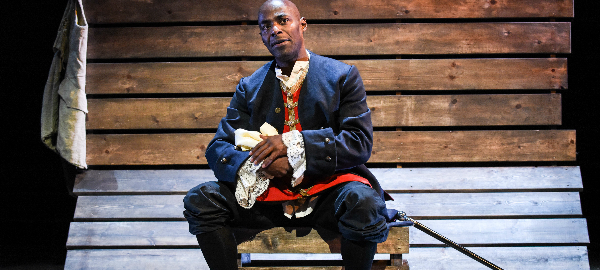
No longer forgotten: Paterson Joseph as Charles Ignatius Sancho. Photo credit: Robert Day
Paterson Joseph is one of the most familiar faces on TV, yet you would be hard pressed to see him on a chat show – out of choice. His penchant for choosing unusual roles has seen him star alongside Leonardo DiCaprio and Tilda Swinton in The Beach, Jill Scott and David Oyelowo in The No. 1 Ladies’ Detective Agency and Charlize Theron in Æon Flux. He caused farcical mayhem in the award-winning comedy classic Green Wing, and in My Shakespeare he went back to his old stomping ground, in Harlesden, to work with young people to stage a production of Romeo and Juliet as part of a Channel 4 documentary. Paterson’s chameleon-like quality is being called upon again, this time in his one-man show, Sancho: An Act of Remembrance, about Charles Ignatius Sancho.
Sancho’s name may not ring any bells, but it should, as he is the first black man to vote in Britain, was an actor and composer, was best friends with actor and theatre manager David Garrick and ended his life running a grocery store in Westminster. Joseph tells Joy Francis the true story behind him being in the frame for Doctor Who, why he turned his back on a potential career as the next Gordon Ramsay, why he was angry at not knowing of Charles Ignatius Sancho’s existence and the importance of clarifying for “Black British kids” that they belong here.
You are starring in the self-penned one man show – Sancho: An Act of Remembrance – about Charles Ignatius Sancho, a black essayist, musician and actor who was immortalised in a painting by Thomas Gainsborough. Like Ira Aldridge, Sancho’s life isn’t as well known as it should be. Why do this show now, and is it a long-held passion for you?
It’s a long-held passion all right. I came to Sancho as a subject around 2005, but I had wanted to write a black history of Britain earlier than that. While filming The Beach [Dir: Danny Boyle], I had a conversation with Tilda Swinton who asked: At the end of your life, what would you like to have achieved? I said I would like to leave something so that the next generation of Black British children would know that this is our country; we belong here. That seed was planted in 1999 when I came across the brilliant Gretchen Holbrook Gerzina’s book, Black England: Life Before Emancipation. Miraculously, after 10 years of working on this project, I met her over Skype as she is doing a programme for BBC Radio 4 on Black Britain, and I am voicing it. Sancho was born on a slave ship and was sent to Greenwich to live with three sisters, but he ran away and was found by the Duke of Montagu who taught him to read and write. He grew up to be a composer and mixed with royalty. He is also the first black man in Britain to vote. The fact that I didn’t know about this man until 2005 is shameful, and made me slightly angry. In my desire for the next generation to know his story, and the fact that I was ignorant of his story, I decided to write this play to give him his due as a black hero.
What do you hope people will learn from Sancho?
That black people in this country are not just visitors who came on the Windrush. We have been here since 200 AD, in Roman Britain times. We had communities living here in Elizabethan England. Queen Elizabeth complained there were “too many of these kinds of people”. You had a black community in Henry VIII’s times. John Blanke was a trumpeter in his court. Yet we have UKIP complaining about immigrants. Were their families here in Roman Britain? It’s about clarifying for Black British kids that they belong here and have a part to play in the history of this country. They don’t need to look to anywhere else for home, as their home is here – if here is where they want home to be. As for Sancho, he is a very entertaining man. I have to pull myself away from being too entertaining, at times. He has a jolly way about him, even when he is saying harsh things socially and politically. He keeps calling himself a visitor and resident. He is a proper icon and a very funny man.
Is this your first one man show and, if so, what are your fears as you will have nowhere to hide?
The terror of going on stage is exacerbated by the fact there is only you, but in a way there is a real focus. The only thing that can go wrong is what you make go wrong. If I can remember 75 minutes of dialogue, then I’m safe. The words are the most important thing. The terror is more about the writing. The writer in me has to take a back seat now, and that has been the most difficult thing to do. The writer says, you can’t cut that line, but the actor says – that’s too long a line. It should go. My director Simon Godwin directed The Beaux Stratagem at the National Theatre and is a brilliant script editor and dramaturg. He is great in the rehearsal room and cuts out the extraneous stuff.
You were about to train as a chef before you found acting. What prompted the transition from food to stage?
I was 17 and a half and was a catering assistant at the Royal Free Hospital. I was about to go to college to do my qualifications to become a chef. I didn’t want to work within four walls – I was qualified to do clerical work – so I thought I’d do something creative with ingredients. Around this time I found an old leaflet for a youth theatre that someone had given me when I was 14. I went to the Cockpit [Theatre] in Marylebone. I was very shy and I didn’t speak very much. I mumbled a lot back then, too. There I was, faced with 16 year olds who were much more confident than me. I knew I wanted to be confident like that. Within an hour of being there I was an actor. Being an actor has released me and is good therapy. Acting changed my life.
How did it feel to be the bookies’ favourite to become the eleventh Doctor Who in 2009?
I was in Botswana filming The No. 1 Ladies’ Detective Agency with the wonderful Jill Scott. I got a message from my agent saying not to answer calls from the Daily Star about the fact I was in the frame to be Doctor Who. I laughed when I heard that as I thought it was a joke. Then I got messages from my friends in England as they woke up to it. It took me ages to realise they weren’t joking. I was shocked. My agent hadn’t heard anything from the Doctor Who people but, eventually, I did audition for the part in London and flew back to Botswana the same day. I didn’t get the part, but I was really gratified there were very few comments saying that you can’t have him, he’s rubbish, or that you can’t have a black Doctor Who.
You have done virtually every genre, from comedy, thriller and blockbuster movies to narration and voiceovers. How have you managed to sustain such a diverse career?
I made a choice a long, long time ago when I was a student that I didn’t want to be pigeonholed into any kind of role. I want to play slaves, beggars, masters, someone who runs a bank or a drugs gang. I want to do that as much as I possibly can. It’s our job to be other people. I have no other agenda than that. I figured I would last longer. That is why I suppose I just say yes to things which are unusual.
Any advice for aspiring actors of colour?
Any actor who is not white, think of yourself as an actor first and everything else will fall into place. If you allow yourself to take on your own ethnicity, you will lose something as an actor. It’s part of, but doesn’t define, you as an actor.
Sancho: An Act of Remembrance is playing at the Birmingham Rep from 22 to 25 September 2015.