After Independence
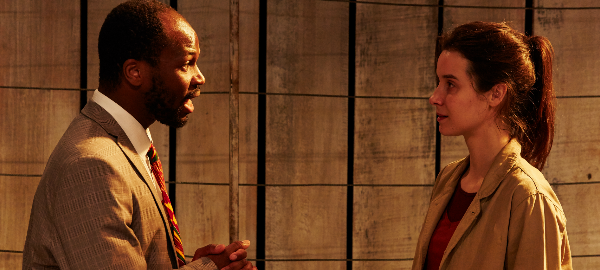
A war of words: Stefan Adegbola (Charles )and Beatriz Romilly (Chipo). Photo: Richard Lakos
Theatre: Arcola Theatre
Play: After Independence
Playwright: May Sumbwanyambe
Director: George Turvey
Review by Joy Francis
After Independence, May Sumbwanyambe’s riveting, intelligent yet flawed full length debut, is set in Zimbabwe in 1998 when Robert Mugabe’s controversial policy of repossessing land from white farmers for the native population was introduced.
Weathered Guy (Peter Guinness) lives an isolated life on an expansive farm, inherited from his father, with his unhappy alcohol-dependent wife Kathleen (Sandra Duncan) and feisty daughter Chipo (Beatriz Romilly).
Sharp-suited government official Charles (Stefan Adegbola) turns up with a fixed smile and a heavy briefcase filled with dossiers and a purchase order for the land, which he wants Guy to sign, swiftly.
A suspicious and resentful Chipo circles Charles like he is prey. Kathleen offers tea and charm while Guy strides around his beloved home full of white privilege and marginal tolerance for Charles’ mission. “This is my farm. Independence is mine,” he asserts.
Instead, this educated black man representing a black-led government is treated like an interloper rather than with the respect he craves. Challenged at every turn, especially by Chipo, Charles succumbs to sarcasm and an intellectual and emotional battle of wills ensues as he struggles to maintain control, and his composure. “I talk when I want to talk, not when I’m told to,” he snaps amid the passive racism.
Charles soon realises that getting a signature on the dotted line will be a drawn out affair when he is forced to stay overnight. Then we see the fissures within the family: the heartbreakingly strained relationship between Chipo, who idolises her father, and her mother; Kathleen’s fear and worry over her husband’s deteriorating health and her desire to be rid of the farm to escape the constant threat of violence from the wayward “bush gangs”.
Determined to leave with the land, Charles engages Guy in a history lesson. Both lay claim to being African, with the farm exchanging hands in Guy’s family for generations. Charles claims to represent the 12 million “silenced voices”; the native people of Zimbabwe. Guy claims to give employment and livelihood to 153 staff, but Charles claims they are only there to make him a profit. In the end, Guy concedes that the previous ‘white’ government ruled “wrongly”, though he accuses the current government of “racism”.
Although Guy relents, Chipo doesn’t. She is full of unfiltered rage, resentment and resistance to change. She is not one to be won over and, after hearing some devastating news, she continues her internal and external fight to a bitter and tragic end.
After Independence takes the risky step of giving a major voice to the white landowner, leaving Charles to carry the weight of the black experience all on his own while trying to earn and retain some respect in a disrespectful situation.
The language of Papatango’s first resident playwright is largely robust, clever and memorable with some unexpected humour cutting through the racial and familial tensions and false niceties. His talent comes into its own in the many two-handed scenes, particularly between Kathleen and Chipo.
What is slightly problematic is that Sumbwanyambe leaves a lot unsaid in the 80 minutes. Also some of the exchanges Charles has with Guy and Chipo occasionally slips out of drama and into exposition, polemic and speechifying in a way that drains the scenes of its emotional connection.
Yet the performances, aided by George Turvey’s confident and restrained direction, are strong and compelling. The scenes between Sandra Duncan’s sorrowful Kathleen and Beatriz Romilly’s disaffected Chipo are potent and claw at the surface of the deeply embedded patriarchy they are both oppressed by, but which is only alluded to. Stefan Adegbola’s Charles is a man of many emotional layers which are desperately contained.
Peter Guinness elicits some surprising sympathy as the defeated Guy, especially in the wake of his repeatedly ambiguous use of the words “your people” or “you people” to Charles. Does he mean civil servants or black people?
The sparse but characterful staging, with its floor to ceiling fencing and minimal wooden furniture, is intimate, bordering on the claustrophobic. And Richard Hammarton’s music and sound design creates arresting and emotive atmospherics from foreboding to heart-pumping urgency.
After Independence has sparks of genius and is a show worth experiencing.
After Independence is at Arcola Theatre until 28 May 2016.