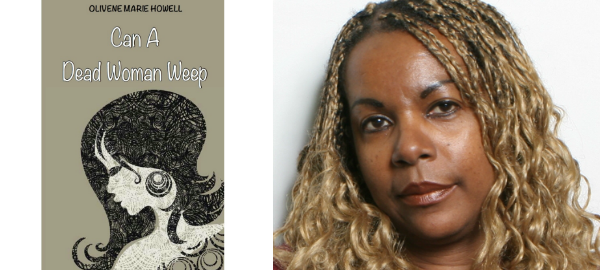
Can a Dead Woman Weep
Book: Can a Dead Woman Weep
Author: Olivene Marie Howell
Publisher: Olivene Marie Howell via YPS Publishing
Review by Joy Francis
Writing your first book is always nerve-wracking. Deciding to self publish, an approach which in the US alone has seen a 59 per cent increase, is even more so. New writer Olivene Marie Howell has taken the plunge with her debut novel Can a Dead Woman Weep, a door stop at two pages shy of 500, tackling class, immigration, mental health, poverty and family estrangement.
Sorrell Evans, an academically bright 16 year old, is the youngest of three children of aspiring Caribbean parents, Bernard (a teacher) and Mildred, a hardened, self-made business woman. Growing up in the West Midlands with her two older brothers no longer at home, Sorrell is treated like an only child, expected to excel in her exams.
After meeting the streetwise, handsome and older Garfield Grant at a family party, Sorrell begins to break out of her shell and becomes conscious of her budding womanhood. During a summer break in London with her aunt, she pursues a relationship with musician Garfield but finds herself in a sexually pressured situation and, with no condom in sight, falls pregnant.
Despite trying to hide the pregnancy from her parents, Sorrell’s mother finds out and goes ballistic, and physically assaults her. Her father is devastated that the apple of his eye has brought shame on the family. One of the only black families living in an affluent white middle class suburb, appearance is everything to them.
When Garfield comes to see her all hell breaks loose. Mildred and Bernard are appalled that he isn’t an educated black man but someone they see as part of the “criminal fraternity”. Sorrell’s mother gives her an ultimatum, the family or Garfield. Sorrell chooses Garfield.
This decision plunges Sorrell into poverty on a sink estate in south London. Forced to abandon her education, she is saddled with two children and an absent and feckless husband. On top of being estranged from her family she finds herself struggling with depression and low self esteem.
A near death experience while pregnant with her third child reunites her with her parents and she begins to transform her life by getting her education back on track and building a career in the financial industry. Despite the positives, Sorrell is kept on emotional edge when her only son, Wesley, starts acting out violently at school, putting himself at risk. To make matters worse, a secret in her errant husband’s life comes back to haunt the family.
Howell seems to want to tell more than one story – that of the experiences of Caribbean people who migrated to Britain post Windrush and a dramatic tale of the challenges facing black men and women in relationships. This tussle goes some way to explain the immense size of the book.
Despite the intimidating scale of the book there are engaging details of Caribbean cultural rituals, from the food and decor to the colloquialism and mannerisms. What is absent is a clear emotional drive in the narrative. This makes it difficult to connect to the characters. Another challenge is the fact that the characters are sometimes indistinguishable in terms of their dialogue. Their moods and reactions are sometimes interchangeable.
Many of the characters move between two emotional states – calm or incredibly angry, making them feel underdeveloped considering the dramatic nature of the story. Emotion seems to have been sacrificed for the carefully crafted back story. Based on the exposition, Mildred is a complex character, but to what degree isn’t teased out in the exchanges with her daughter or her husband.
Garfield’s alleged charm remains a mystery. It is difficult to see what Sorrell finds alluring about him considering his limited vocabulary, poor prospects and inability to see Sorrell for who she is. He also seems to undergo a character change from when he met her to when she falls pregnant. His bullishness and increasingly heavy Jamaican patois makes him appear possessed by another character’s personality.
Sorrell’s endearing character traits as a teenager – intriguing, perceptive, intelligent and warm – become minimised as she gets older. Yes, she finds herself in an unwanted domestic situation, but her explosive and expletive laden reactions to her son’s troubled misadventures feel more like what Mildred would do, not Sorrell who didn’t swear and seemed more thoughtful as a teenager.
Can a Dead Woman Weep would have been a more pacy and engrossing read if it was cut in half, with a stronger sense of place and time. Howell is clearly passionate and knowledgeable about the topic, so if you want a realistic slice of Caribbean life across the generations then this book is worth a punt.
To purchase a copy of the book click here.