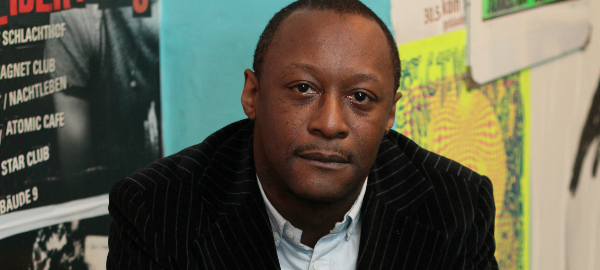
Courttia Newland and The Almasi League
In March 2014, award-winning novelist Courttia Newland launched The Almasi League Writers’ Programme with the Newham New Deal Partnership. Over 12 months, Newland mentored 10 emerging London writers from African, Asian, Caribbean and Oceanic backgrounds through group workshops and one to one tutorials, with access to established writers and editors such as Ella Allfrey and Linton Kwesi Johnson. Since the programme’s end, some of the writers have captured the attention of editors and playwrights with one already nominated for various national writing prizes
With the publication of Spread the Word’s Writing the Future report and the planned #diverseauthorday on Twitter on 24 September 2015, Joy Francis asks Newland why programmes like his are necessary, why Black British writing gets shortchanged and his plans to get the programme accepted as a university module.
Why the name The Almasi League?
Almasi is Swahili for ‘diamond’ so it’s the diamond league. I wanted the writers to feel good about themselves, and feel like people cared about them and their writing goals. I thought it would be good to have a name which speaks to their self esteem, but in a more subtle way. By chance we did have a Swahili speaker in the class. The name also lets them know what is expected of them and the esteem in which they are held.
Why did you launch this writing programme in Newham for writers of colour?
It came out of the work I had been doing with Words of Colour Productions, the diversity and publishing agenda with English PEN and Spread the Word, the presence of the Lenny Henry plan at the British Film Institute and the launch of the Act for Change project. I felt like I needed to do something. I had also just moved to east London and I wanted to make myself useful. While taking my son to nursery I bumped into Jessica Wanamaker [former chief executive of Newham NDP] and she spoke about wanting to get more diversity into the building and the work they were doing with creatives. They asked if I had any ideas and I came up with the programme. She applied for funding from Arts Council England (ACE) and it all fell into place.
How does the programme work?
It ran for over a year. There were 10 writers who were politically black and Asian. They had one workshop a month and each writer had two one hour tutorials with me and they were invited to any initiatives which were happening. We had an email network to The Literary Consultancy, Free Reads with Spread the Word, and anything that pertained to their practice. Former Granta deputy editor Ella Allfrey and award-winning screenwriting Daniel Fajemisin-Duncan gave a lecture.
There are many persistent fallacies as to why more British writers of colour are not published – from the ‘quality’ debate to being too niche. What has come to light based on the writers you worked with?
Black writers are not being nurtured according to their strengths. Instead, their strengths are labelled as weaknesses. While Ben Okri talks about the heaviness in black subject matters, I have been keen not to dictate to writers what they are writing, but to help them to write it better. Among the writers there was a slavery narrative, a gangsta narrative on a council estate in east London and a gangsta narrative set in New York. But there were also stories which derived from fairy tales and an African collection of stories which were interlinked and the city was the character, almost like Cannery Row. There was also a play about the invisibility of British Chinese people in society, like an extended metaphor, written in an allegorical way about people who couldn’t remember who they were. The diversity of black writing is why I want to do programmes like this to show what is possible
Why are programmes like yours, which operate outside of mainstream publishing, so important in the current climate?
The programme is important as these are writers that could have been missed. We need to support black writers to win literary prizes or writers who would otherwise not be supported. We need to allow them to give an accurate representation of society as people know it isn’t accurate in terms of the literature being published now. The question is, what are we doing about it?
How has your programme benefitted the writers?
One of our British Chinese writers was connected with writer and actor Daniel York as she is a playwright, and he is mentoring and working with her. Our writers were also encouraged to network and meet with those in the industry. Ella [Allfrey] met up with one of the writers whose work interested her and she is going to publish her work in a Spread the Word anthology. Another writer has been nominated for the Pushcart Prize, the Caine Prize and the SI Leeds literary prize. It has been very beneficial in terms of their confidence.
What next for the programme?
We will continue the programme, but in a more focused way. Maybe with fewer writers, possibly five, so they can get more quality time. There will be workshops, but not a year’s worth. There will be a larger programme of mentorships with a concentrated group of writers. They will also have more input from other published authors. Ultimately, I would like to partner with a university and have an ongoing programme, whether that would be Black British Studies with creative writing edge, or creative writing alone. Just teaching a room full of black writers in a political sense, with this entire literary heritage they had heard of but had never read or encountered, is important. We had a module reader where we looked at Toni Morrison and Zadie Smith essays, David Dabydeen’s literary theory from an African heritage perspective, and George Orwell and African diaspora literary theory. Nine times out of 10 the writers hadn’t read them before. This is not offered on MA degrees here; maybe in the US, but generally not in the UK. We are getting black writers to engage in the blueprint of African diaspora literature which already exists and which can help them.
What next for you?
Completing my PhD in Diaspora Aesthetics in Black British Literature at Kingston University. I am part of the Revolution Mix programme at Eclipse Theatre for playwrights. It’s nice to be on a programme like that rather than teaching on one. I’m developing a play which should hopefully be produced next year with Theatre 503. And I’ve got a short story in a sex and death anthology by Faber and Faber, which will be out in the autumn 2015. It features 20 of world’s best short story writers. And I’m working on my sci-fi collection of short stories, as well as teaching.
In part two of the series, two of The Almasi League alumni talk about how the programme has made a positive difference to their writing careers.