How Nigeria Became: A story, and a spear that didn’t work
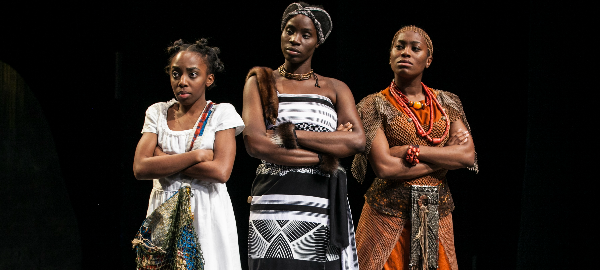
Creative differences: Rita Balogun (Innoncence), Rebecca Omogbehin (Chinedu) and Stephanie Levi-John (Esomo). Photo credit: Matt Hargraves
Play: How Nigeria Became: A story, and a spear that didn’t work
Theatre: Unicorn Theatre
Playwright: Gbolahan Obisesan
Director: Gbolahan Obisesan
Review by Joy Francis
Director and playwright Gbolahan Obisesan’s ability to imaginatively combine history, humour and Yoruba folklore has resulted in an uneven but engaging play about the creation of Nigeria 100 years ago.
Oduduwa (a wide-eyed Rita Balogun), an apprentice god, is sent to earth in 1914, along with Eddie the chicken (a real one), to locate the Spear of Shango. Shango, the son of the sky god who was given the responsibility of ruling over the newly formed Nigeria, was chased out of the country by his unhappy subjects.
As he fled on his unicorn he dropped his enchanted spear causing a seismic crack at the crossroads of all the kingdoms, with each one claiming the weapon as their own. To keep some semblance of peace, it was decided that whichever kingdom found the spear could keep it for a year before allowing the other kingdoms to compete for its temporary ownership.
This Yoruba legend sets the context for the play within a play where a theatre troupe of women led by Herbert Ogunde (Tunji Falana) debate what story to perform. The actors, made up of Herbert’s two wives Esomo (Stephanie Levi-John) and Chinedu (Rebecca Omogbehin), dislike each other but both want more say in the creative decision-making process. Being married to Herbert is the only way they can perform and have a career as women, but they are feeling stifled by the arrangement.
Innocence (Balogun), a young aspiring actress, persuades Herbert to allow her to join the company after an awkward audition. While the theatre troupe squabble over what play to perform Charles (a bumbling Christian Roe), a colonial messenger, is sent by the British governor to commission Herbert’s theatre company to perform at a special unity celebration for the newly formed Nigeria.
After being enticed by a handsome fee, the women demand that they perform the story of the spear of Shango with Innocence in the lead role. The story, a rites of passage tale, follows the young Jenrola’s quest to retrieve the spear for its powers to bestow riches on her kingdom.
Of course Jenrola’s quest wouldn’t be complete without conflict and obstacles, including competitive female warriors from neighbouring kingdoms who also want the spear, a wise old man and a wily hunter who holds the key to the spear’s location. As Charles watches the rehearsal, he suggests rewrites to the story to fit the ‘colonial’ version of a united Nigeria.
The audience of junior school children and teenagers have a mixed response to the production. The children gasp at the dramatic opening and shout out their solutions to the riddles presented for the warriors to solve. This enthusiasm isn’t reciprocated by the teenagers.
As for the gender politics, Herbert’s polygomy and patriarchal approach, and the sprinkle of sexism in the play, especially the hunter’s adulterous interest in Innocence, go over the children’s heads. The adult subject matter could have been better signposted and challenged within the narrative to be more accessible to the target age group.
The cast is great. Five multi skilled actors (with four playing more than one part) mix acting with elements of physical theatre and buoyant African dancing. Obisesan’s writing is smooth, witty and pacy, and is packed with historical details while Rajha Shakiry’s spare but colourful and inventive set, including animations, a jigsaw-like stage and adaptable set capture, the rural backdrop and mystical tone.
Although a creative version of Nigeria’s complex formation in 1914, How Nigeria Became is strictly one for the kids.
How Nigeria Became: A story, and a spear that didn’t work will be at the Unicorn Theatre until 9 November 2014.