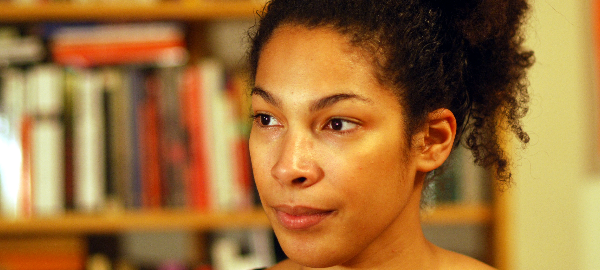
Interview with Jackie Sibblies Drury
Photo by Sebastian Venuat
Brooklyn-based playwright Jackie Sibblies Drury first planned to be an actor. After realising that she would prefer to never leave the rehearsal room she switched to writing plays, with almost immediate success. A graduate of Brown University’s MFA playwriting programme, she received a Weston Award and the David Wickham Prize in Playwrighting. Her latest play, We Are Proud to Present a Presentation About the Herero of Namibia, Formerly Known as Southwest Africa, From the German Sudwestafrika, Between the Years 1884 – 1915, won the Edgerton New Play Award and is now having its European Premiere at the Bush Theatre in London. Sibblies Drury tells Joy Francis about her aversion to performing in front of people, her love of British theatre and why she hates the term “post racial America”.
Tell me a bit about We Are Proud to Present.
The play is about a group of actors – three black and three white – who are interested in creating a theatre piece about the first genocide in Southern Africa before World War I by the German government. The play follows the actors as they create this theatre piece about race in contemporary Britain. When I wrote the piece I based it in America so it has been an interesting process of translation.
What was the pull for you to write this play?
I started to write the play after Barack Obama was elected to his first term in what was described as post racial America. It became such a popular term, one which I hate. Although it was gratifying seeing him as our first African American President, the conversation quickly turned to racism being over and the relief that this chapter of our history had ended when this was so clearly wrong and inaccurate. I wanted to write a play that focused on the topic of race relations.
The play was a critical success in the US, so why showcase it in London?
I hope that it’s also relevant here. It seems as though British audiences are excited to engage with stories that are different from the norm. Genocide is very present in our daily news, with Syria for example, and on film from Hotel Rwanda to 12 Years A Slave. What is it about the theatre form that enables these traumatic stories to resonate universally? Theatre is well suited to talk about complex and difficult issues. There is an essay by German playwright Friedrich Schiller which talks about the theatre as a moral institution, a place to put things that are immoral on trial. You don’t have the verisimilitude of film. When we are talking about genocide there are six actors on stage with lighting, sets and props, but they don’t have access to thousands of bodies and realistic [special] effects that a film can access. But in its inability to mirror exactly, a play is able to show more and relies on the audience’s imagination to fill in the gaps.
You originally trained in acting but seemed to fall into writing when you fell out of love with the idea of being an actor. How did you make that transition?
You are so right. When I went to college I didn’t know exactly what I wanted to do, but thought being an actor would be awesome. The bits I liked were being in the rehearsal room and reading the script really closely. I loved creating character; I just didn’t actually like the performance part – at all. With writing it is the specificity of words and being able to play with all of these ideas but I don’t have to be the person who is embodying them in front of people.
What is your view of the theatre scene in London compared to the US?
It seems like theatre is so much a part of everyday life in London, so much more than in New York. When I was going through customs they knew about the Bush Theatre and the taxi driver mention Dario Fo, which is not the case in New York. People here are really rigorous with their theatre. There are so many newspapers and the theatre reviews are very different and more thought through. Also you can see a play for £10 to £20. In New York we are talking thousands of pounds. Here, you know people can afford to see your show.
What next for you?
After this play opens, I will go to a remote area in Morocco in the south called Western Sahara, a contested territory. I will be doing research for what will hopefully be an interesting new play in a year or two. At the moment it is just an idea.
What advice do you have for any budding writers of colour, based on your own interesting journey?
Write as much as you can and learn to write by writing is my advice. When I’m feeling optimistic it seems that the particular perspective of writers of colour is something that is being valued in theatre. As long as writers of colour value their own voices and own unique perspectives, then others will value them more. I hope they aren’t feeling the need to write plays that tackle issues in ways they think mainstream theatre wants them to. Hopefully they can hold onto their own unique perspectives to tell stories the way they want them to be told.
We Are Proud to Present a Presentation About the Herero of Namibia, Formerly Known as Southwest Africa, From the German Sudwestafrika, Between the Years 1884 – 1915 is at the Bush Theatre until Saturday 12 April 2014.