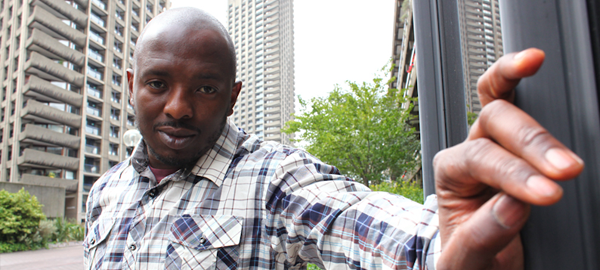
Interview with Nick Makoha
Nick Makoha describes his poetry as “weird”. The Ugandan-born, London-based poet has been honing his craft for nearly 12 years. Makoha is one of 10 new poets selected for Spread the Word’s Complete Works development programme, which led to the Ten Anthology (2010).
He recently toured his one man show My Father & Other Superheroes about absent fathers. The former resident artist of Spoke-Lab and writer-in-residence for Newham Libraries explains to Joy Francis his inspirations and why poetry can transform young people’s lives.
How would you describe your poetry?
My poetry is weird. I’m a poet in exile as a lot of my poetry is about being from somewhere else. T. S. Eliot has been described as a metic, one who writes of his experience of living in another country. All my writing is about the experience of being in another country and feeling that you belong to both at the same time.
What drives this sense of otherness for you?
Although I have been writing professionally for over 11 years, it is only in the last four yeas that there has been an awakening in my consciousness about what I’ve been writing about. I am from Uganda and I’m here because my parents were forced out under the Idi Amin regime. Even though I have a Western consciousness, part of my thinking is African, which occurs to me like a ghost.
As one of 10 contemporary UK poets selected for the Complete Works development programme, you were mentored by eminent Hungarian poet George Szirtes. What was that like?
It was like meeting a wizard. His first words to me were “Nick, I will always be there for you”. He was looking for an authentic poet. I don’t know what that is but the programme is finished but he is still a phone call away. You have to understand that as a writer you are contributing to a lake of voices. I’m talking about T.S. Eliot and Shakespeare in Western culture. In Asian culture it’s the Haiku writers. In East Africa you have the orators. The mentor, in my case George [Szirtes], opens you up to that lake and gives you a ground to stand on.
You are director of the Youth Poetry Network. Has poetry been used by the young people to reflect on the riots and how they were covered?
Not directly. We take some of our young poets to Chicago as part of the London-Chicago Teenage Poetry Slams. Late last year we took four young people whose theme was the riots. I am about what young people can do, not what they can’t do. We do that through language and self expression. This gives them confidence, which then gives them the ability to think about what is possible. That is what the Youth Poetry Network is about.
You recently toured your one man show My Father & Other Superheroes about absent fathers. Why this theme?
I want people to bring the conversation of the father back into the household. When the father is stigmatised, you also stigmatise the family and the mother. I wanted to address this in my own life and in wider society. It started when my daughter was born. I realised that I didn’t know how to be a father and this flaw was something I was uncomfortable with. I have two children now.
Do you think there is a poetry revival taking place or is it still a struggle?
There have been revivals in the past. I would say it is more of an awakening. Shakespeare spoke in the colloquial language of his time. You can relate him to rapper Jay Z, who also relates to his community but also transcends his community and has gone global. When you highlight this to young people, they begin to see that they belong to a continuum of language and that language is a catalyst for change. This language, including poetry, belongs to everyone.
[toggle title=”Read an extract from Makoha’s poem Beatitude.”]
When a rebel leader promises you the world seen in commercials,
he will hold a shotgun to the radio announcer’s mouth,
and use a quilt of bristling static to muffle the tears.
When the bodies disappear, discarded like the husk of mangoes.
He will weep with you in those hours of reckoning and judgement
into the hollow night when the crowds disperse.
When by paraffin light his whiskey breath tells you
your mother’s wailings in your father’s bed are a song
for our nation, sits with you on the veranda to witness the sunrise,
say nothing. Slaughter your herd. Feed the soldiers
who looted your mills and factories. Let them dance
in your garden while an old man watches.
Then when they sleep and your blood turns to kerosene,
find your mother gathering water at the well to stave off
the burning. Shave her head with a razor from the kiosk.
When the fury has gathered, take her hand and run
past the fields an odour of blood and bones. Past the checkpoint,
past the swamp to towards the smoky disc flaring in the horizon.
Run till your knuckles become as white as handkerchiefs,
Run into the night’s fluorescent silence. Run till your lungs
become a furnace of flames. Run past the border.
Run till you no longer see yourself in other men’s eyes.
Run past sleep, past darkness visible.
Stop when you find a country where they do not know your name.
©Copyright Nicholas Makoha 2012 [/toggle]