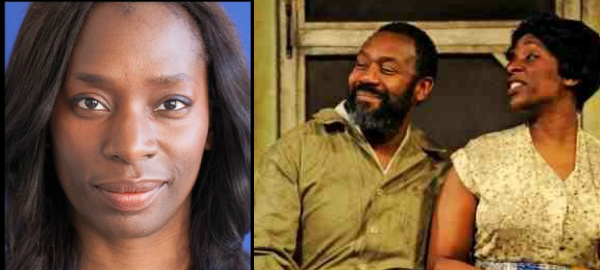
Interview with Tanya Moodie
Tanya Moodie is a critically acclaimed actor whose 20 plus years career has seen her work with leading directors such as Peter Brook, play meaty dramatic roles, including Euripides’ Medea and Nora in Chekhov’s A Doll’s House, as well as appear in highly rated BBC1 hit programmes The Street and Sherlock.
Born in Canada to Jamaican parents, the fluent French speaker and practicing Buddhist came to England in her late teens and studied at RADA, where she is now an associate teacher. Currently receiving strong reviews as Rose in Paulette Randall’s acclaimed West End production of August Wilson’s Fences, Moodie speaks candidly to Joy Francis about the challenges of the profession, her reticent over colourblind casting and her key criteria for accepting a role.
How are you finding the positive reaction to your character Rose in August Wilson’s Fences alongside Lenny Henry?
The strongest reaction I’ve had was from a man while the play was on tour. He was completely with Rose’s character. He felt moved and hugged me. Rose is so phenomenally well written. August [Wilson] writes in such a comprehensive and humane way that Rose is incredibly rich, profound and three dimensional. You feel that August knows this woman and because of that she has the power for people to experience her very subjectively.
During the Walk in the Light discussions at the National Theatre, you expressed some reticence towards the concept of colourblind casting. Why?
It is an outmoded and outdated concept. It came into my consciousness in the 80s when the debate was that casting should be based on talent and this term was a catch all. It was saying – we want you to recognise our talent before our ethnicity, which I completely agree with. However I don’t think that it is possible to be blind to someone’s colour. When I played Nora in a Doll’s House I played a Norwegian woman. I was the best person for the job and got great reviews. I didn’t expect people to be blind to the fact that I was black.
What determines what roles you play as you have been in quite a few of the classics?
I have spoken a range of words from Euripides to debbie tucker green so my roles have been quite mixed. Being a jobbing actor it is hard to say no to everything but I have criteria that I use. An older actress told me years ago that when you are choosing a part you have to look at money, the part – which includes the play – and then the venue, which includes the director. If at least two out of the three are present then it’s a yes. If not, then it’s a no. I was offered a new play written by a black woman to show at Theatre Royal Stratford East. I had to turn it down as I would have to start rehearsing two days after Fences finishes. I have a five year old daughter. If they said it started a month later I would have said yes.
As a black actor, what are the key ingredients you need to have to enable you to have longevity in your career?
I think the ingredients are universal, whatever your gender or race. They are wisdom, courage, compassion and energy. When I say wisdom, it is about thinking with your mind and your heart at the same time. Every artist knows instinctively what courage means and it takes practice to have that courage. You need to have compassion for yourself. I’ve had terrible times in this business. You can’t always get it right or get the job. You also need to have boundless energy, which is about your health. There’s healthy eating. Sleep is a big thing. Don’t drink too much. I decided at 17 I wanted to be an actor. I’m 41 and I’m only just learning to eat healthily. I’ve been seeing a personal trainer since I started on Fences. All of this creates longevity.
Fences is at the Duchess Theatre until 14 September 2013.
@tanyamoodie