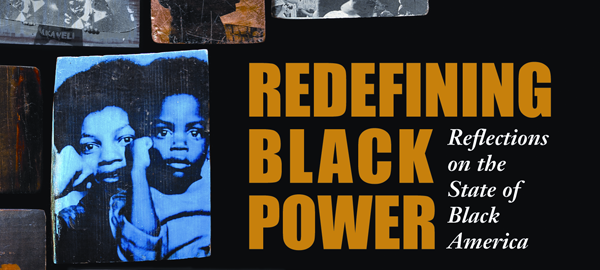
Redefining Black Power: Reflections on the state of Black America
Editor: Joanne Griffith
Price: $16.95
Publisher: City Lights Books
Review by Bengono Bessala
In her new book, British-born and LA-based journalist Joanne Griffith uses interviews with renowned African-American journalists, activists and educators to look at the effect the election of Barack Obama has had on Black America.
Billed as an open and ongoing discussion, the book’s foreword by Brian DeShazor, director of the Pacifica Radio Archives, states that Griffith’s work “is not a space for answers” but a place to “Digest. Discuss. Share. Speak out. Act.”
This partly explains why the author doesn’t reflect greatly on the answers given by each interviewee. That said some self reflection after each interview would have been useful to show why the contributors were chosen for the book.
Each interviews starts with a brief introduction to the contributor, followed by their take the current state of the African-American community. For example, Dr Julianne Malveaux highlights important facts about the financial difficulties faced by African-American women.
Shocking statistics gathered from research by the Insight Centre for Community Economic Development in 2010 show that unmarried African-American women aged between 36 and 49 only have an average wealth of $5, compared to the their $42,000 average held by their white counterparts.
One of the most memorable messages in the book comes from Ramona Africa, a political prisoner and minister of communication for the MOVE revolutionary organisation. Africa quotes political activist Fred Hampton Jr by stating that “Barack Obama is the new crack. He has anesthetised people”. Africa also believes that “people need to stop looking for a saviour…we the people are our own saviours”.
This is a recurrent theme in the answers of most of the contributors, including Dr Vincent Harding, a close friend of Dr Martin Luther King Jr. Harding says: “There is always a tendency [for us] to build a Messiah, so that we do not do any saving work ourselves.” Van Jones, who served as the green jobs adviser to Obama in 2009, adds that “people act like Barack is going to save America…if there’s anything wrong with Black America don’t blame him”.
As a result, the book shifts from being an exploration of the Obama effect on African-Americans to an analysis of how far they have come in mainstream society. This approach explains the book’s cover, which features pictures of well-known African-American activists, including Muhammad Ali.
With each interview following the same Q&A format, a sense of repetition emerges towards the end of the book. Also little gems, such as journalist Esther Armah’s discussion with Griffith on the symbolic impact of the Obama family on future generations of African-Americans, are tucked away in the final chapters.
At the end of Redefining Black Power you are left with no real conclusion. All Griffith asks is that the reader look not at “what can President Obama do for us” but at “what we can do for ourselves”, which seems reasonable enough.