Selma
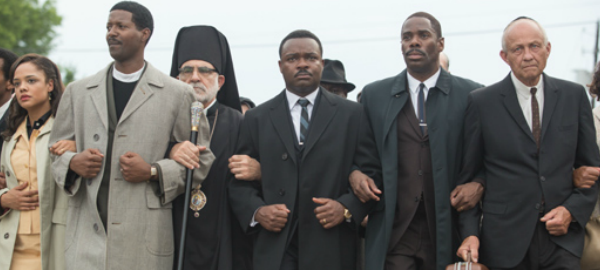
The Selma march: Corey Reynolds (Rev. C.T. Vivian), David Oyelowo (Martin Luther King Jr) and Colman Domingo (Ralph Abernathy)
Film: Selma
Director: Ava DuVernay
Screenplay: Paul Webb
Genre: Drama
Review by Joy Francis
Dr Martin Luther King, Jr is a global legend; a man whose powerfully eloquent words still resonate today, across all ages and races. So director Ava DuVernay’s attempt to immortalise his life on screen will be subject to intense scrutiny to decide whether she is a safe pair of hands to reflect his legacy.
Selma focuses on the events leading up to the momentous solidarity march from Selma to Montgomery, Alabama in 1965, to secure equal voting rights for African Americans. It led to the overdue signing of the Voting Rights Act that same year, but at a cost.
It’s 1964. King (a towering and impressive David Oyelowo) has already delivered his iconic “I have a dream” speech and is about to be presented with the Nobel Peace Prize in Oslo, Norway, for his civil rights work. This honour is at odds with King’s original plan to be a pastor and lecturer in a small town, but “history had other plans”.
By 1965 King’s international profile is on the rise. Lyndon B. Johnson (a cantankerous Tom Wilkinson) has been elected president and the brutal resistance to desegregation in the South shows no sign of abating.
King and his dream team, including Andrew Young (Andre Holland), Ralph Abernathy (Colman Domingo), Bayard Rustin (Ruben Santiago-Hudson), James Orange (Omar J Dorsey) and Diane Nash (Tessa Thompson), realise they have to shake things up politically to secure lasting change.
This requires King to repeatedly lobby the president to pass the Voting Rights Act and locate a new staging ground or “citadel” to make their voices heard. Selma, Alabama is selected. Despite 50 per cent of its population being African American, only 2 per cent are allowed to vote.
The campaign team decide to use the media spotlight to show white America and Johnson the barbaric treatment of African Americans in the land of the free to force change. “We need to be on the TV news every night and that requires drama,” admits King.

Sparring partners: Tom Wilkinson (Lyndon B. Johnson) with David Oyelowo (King).
King faces competing demands and resistance at every turn. Johnson, living in the shadow of his recently assassinated predecessor John F. Kennedy, sees King as a distracting arrogant negro and potential obstacle to his presidential legacy.
Staunch segregationist, Governor George Wallace (a convincingly creepy Tim Roth), wants to keep the status quo intact and teach King a lesson. The Student Nonviolent Coordinating Committee, based in Selma, is divided over King marching into their turf and undermining their civil rights efforts.

Marriage under strain: David Oyelowo (King) with Carmen Ejogo (Coretta King).
And FBI chief J Edgar Hoover (Dylan Baker) categorises King as a deviant threat and wire taps the King family’s phone to gather information to destroy his already strained marriage to Coretta (an assured performance by Carmen Ejogo). King knows the only way he will get justice for his people is to push ahead with the march in Selma, despite risk to life and limb by the openly racist and violent state troopers.
Selma shows the devastating cost to the lives of many African Americans, and a few white American activists, before the peaceful procession was allowed to finally happen (at the third attempt). It also highlights the ever-present double standard where the race is concerned: that white lives are valued over black lives, typified by the #blacklivesmatter hashtag.
There is so much to say about this film. The performances are stellar with British talent out in full force. Tim Roth is effortlessly unpleasant as George Wallace while Tom Wilkinson convincingly conveys Lyndon B. Johnson’s ego, latent racism and begrudging admiration for King. Carmen Ejogo’s Coretta is modern, elegant, strong and dignified.

Rousing speaker: David Oyelowo (King).
As for David Oyelowo, he is exceptional. His King is an understated, graceful and powerful portrayal. It would be easy to overplay King. Instead Oyelowo adds light and shade while showing the great man’s inner turmoil.
DuVernay’s visually confident and glossy Selma firmly takes King off the towering pedestal and presents him as an everyman. We see him humbled, flawed and passionate with the allegations of his infidelity touched upon. She chooses to humanise a legend often forced into dealing with dehumanising situations.
During a spiritual low point, King calls jazz legend Mahalia Jackson (played by soul singer Ledisi) in the middle of the night and says: “I need to hear the Lord’s voice”. She sings to him, like a mother singing a lullaby to her baby boy.
Eight years in the making, DuVernay had to compromise on Selma. It is widely reported that as Stephen Spielberg has the rights to King’s speeches, she and Paul Webb had the unenviable task of rewriting them. They just about get away with it as the dialogue is lyrical, contemporary, informative and, for the most part, exudes quality.
King was a man with an unenviable task – to convince a superpower to accept its African Americans citizens as equal to white people in the eyes of the law – and in life. To this end people were beaten, terrorised and killed. There is a sense that King felt he had blood on his hands. By the time Johnson, flanked by King, signed the Voting Rights Act in 1965, it must have felt like a hollow but miraculous victory.
Against the painful backdrop of the deaths of Eric Garner and Michael Brown in the US, the tragic events leading up to Selma in 1965 remains timely as we are still left with the question: how far we have we truly come?
Selma opens nationwide from Friday 6 February 2015.
Watch the trailer