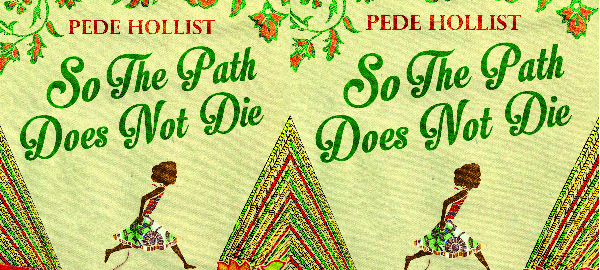
So The Path Does Not Die
Book: So The Path Does Not Die
Author: Pede Hollist
Publisher: Jacaranda Books
Price: £12.99
Review by Natalie Gormally
The World Health Organisation estimates that up to 140 million women and girls have been subjected to genital mutilation across the world. Those who support the practice claim it protects women’s so-called “honour”, believing that a woman’s sexuality must be controlled.
Female circumcision is one of the many themes of So The Path Does Not Die, a story about Finaba Marah, a young woman from Sierra Leone who makes a new life for herself in the US, only to later return to her native Africa.
Pede Hollist’s first novel doesn’t shy away from difficult issues, which may be one of the reasons for its success at the 2013 Caine Prize for African Writing. Sierra Leone has one of the highest rates of female genital mutilation in the world. It is a taboo subject – shrouded in religion, long-held cultural rituals and sociocultural factors that support the persistence of the practice.
The prologue sets the scene for a tale of tension between tradition and change, while Finaba’s story provides the basis for Hollist to explore the complex and integrated themes of African identity, gender, sexuality and exile.
Finaba is born in a tiny village in Sierra Leone, heavily steeped in tradition. So when her father bravely disrupts her initiation tribal ritual of circumcision, and turns away from the tribe’s well-trodden cultural path, the family is ostracised and forced to leave their community.
A move to the capital results in further hardship for Finaba and her family. Her name is shortened to Fina to sound less alien and, against the odds, she gains an education. The narrative moves along quickly and in the second half of the book, Fina makes it to America. But the path from Africa to the USA is once again not without its challenges.
When in America, she once again faces exclusion, this time based on race. The structural inequities are displayed, including the country’s materialistic proclivity, culture of individualism and lack of community generosity, which forces Fina to rethink her idea of “home” and where her yearning for a sense of belonging will take her next.
All is not downbeat as she falls in love with Cammy, a Trinidadian medical doctor. Sadly for Fina, nothing runs smoothly for long. Rather than be “an occasional African”, she returns to Sierra Leone after it has been ravaged by civil war.
Guided by overarching themes of tradition, change and exile, each sub-plot explores the complex problems Fina encounters – from her aborted rites of passage to inter-ethnic hostility, to African American immigration and finally to her return to a place she is still unsure if it is home.
Hollist fuses of proverbs, metaphors, similes and symbolism to enhance his message and demonstrate the conflict between tradition and modernity.
Dialogue is used to set out different points of view. One example is the debate between African American and American Caribbean friends on the existence of a “Diaspora complex”. Hollist uses this lively exchange to show the cultural and transcultural differences facing communities arriving in Western nations while they maintain their more controversial traditional practices, such as female genital mutilation.
While the story reads easily, the narrative advances at an unrelenting pace. As a result, some of its cultural complexities could have benefited with a little more room to breathe.
Focusing on the lives of women and girls is an admirable and ambitious approach from a male writer. That said the story may have been strengthened if told directly from the mouth of Fina, rather than in third person, and there is a lot of story to pack in.
What you are left with is a thought-provoking and engaging coming of age story which is ultimately about a young woman’s fight for identity and survival.