The Low Road
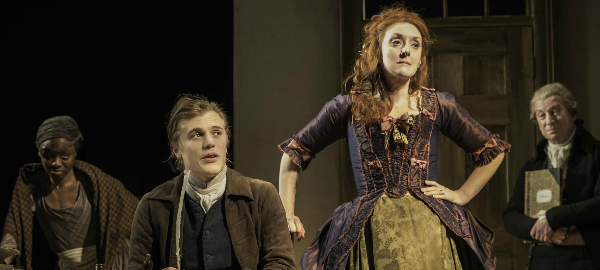
The influence of capitalism: Natasha Gordon (Old One-Eyed Tizzy), Johnny Flynn (Jim Trumpett), Elizabeth Berrington (Mrs Trumpett) and Bill Paterson (Adam Smith). Picture by Johan Persson
Play: The Low Road
Theatre: Jerwood Theatre, Royal Court
Playwright: Bruce Norris
Review by Natalie Gormally
The Low Road reunites the Royal Court’s departing artistic director Dominic Cooke with American playwright Bruce Norris in a rambunctious affair.
Set in pre-revolutionary America, Norris serves up his satirical take on the excesses of capitalism. Clearly Cooke’s swan song, it is a marathon three-hour gala, with a cast of over 50 characters played by 20 actors.
Our protagonist Jim Trumpett (Johnny Flynn) is an orphan, abandoned on a Massachusetts brothel doorstep, and the likely son of a common thief. Despite his debased beginnings, Trumpett sets his sights on a more prosperous future. When a ruinous incident provides the opportunity, Trumpett sets off in ruthless pursuit of profit, armed with a dubious share of the brothel’s takings.
Trumpett’s journey epitomises the very essence of economic freedom – an individual’s rights to pursue his financial goals. What Norris wants us to recognise is that this is often achieved at the misfortune of others.
The story is framed by the witty and dry narrations of Scottish political economist Adam Smith – a superbly cast Bill Paterson. The steady flow of jokes proves popular with the audience and provides some respite as Norris, true to form, addresses challenging issues such as slavery.
Trumpett’s first acquisition is that of John Blanke, an African slave, raised and educated by an English Lord, the rightful Earl of Rivington. The men are contraries in nearly every way. Blanke, played effortlessly by a captivating Kobna Holdbrook-Smith, is denied his freedom, yet possesses all the qualities Trumpett is deficient in: benevolence, dignity and elegance. From this point their lives become both literally and metaphorically bound together.
If the audience was in any doubt about the play’s theme, act two opens briefly with an unexpected use of parody in a scene set in a modern day global economic crisis conference. The cast, unrecognisable as a new set of characters, perform brilliantly, with Elizabeth Berrington shining as the conference’s patronising chair.
Back to the 18th century and the men’s circumstances appear to improve, as both Trumpett and Blanke are taken under the wing of wealthy New York liberal Issac Low (played by John Ramm). But all is not well for long as Blanke realises that freedom is nothing more than liberal dinner party conversation.
Norris does not shy away from the difficult themes of race and inequality, as highlighted in his award-winning play Clybourne Park, and isn’t afraid to wave a finger at middle-class liberal hypocrisy. Meanwhile Trumpett’s mismanagement of the household’s finances detonates a further trail of destruction, eventually leading to a fatal consequence.
Norris isn’t subtle. The play’s theme and his political stance are clear from the outset, which feels like an oversimplified jab at capitalism. Only at the end do we see some clear roots to the argument. Frustratingly, we are left with no conclusion as to how Norris sees a way out of the capitalist malaise. Despite this lack of clarity, he delivers an enjoyable satirical performance that makes a minor contribution to ongoing debate on the global recession.
The Low Road runs at the Royal Court Theatre until 11 May 2013