To Kill a Mockingbird
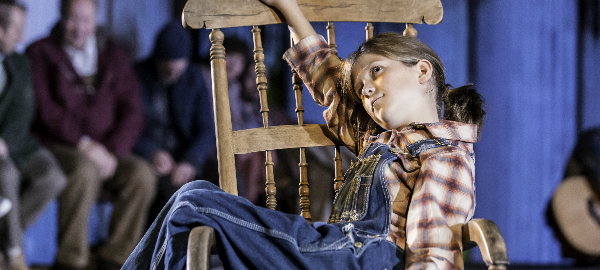
Too much, too young: Jemima Bennett (Scout). Photo credit: Johan Persson
Play: To Kill a Mockingbird
Theatre: The Lowry, Salford
Playwright: Adapted for the stage by Christopher Sergel
Director: Timothy Sheader
Review by Carl Palmer
The enchantment of Harper Lee’s Pulitzer Prize winning novel To Kill a Mockingbird is present from the start of Christopher Sergel’s stage adaptation of the beloved classic.
Judging from the excited school groups who filed into The Lowry, the story still resonates with audiences of all ages. Does this abiding touchstone in American literary and social history deliver theatrically? The answer is a resounding yes.
Whatever your experience of reading the book, your individual focus will be tested in this stage version of what is essentially a story about right and wrong when a black man is falsely accused of raping a white woman.
A quote from the book – “Shoot all the blue jays you want, if you can hit ’em, but remember it’s a sin to kill a mockingbird” – is an allegory and an indelible message that runs throughout the play and sticks to your conscience like a limpet.
When the cast assemble at the foot of the stage, each holding a different paperback copy of the novel, you instantly feel the audience is gathered to hear a reading of the text.
Told through the eyes of Scout Finch (played by the charming Jemima Bennett), and set in Alabama, the folksy guitar playing and singing, hop scotch lines and bushy tree, are beautifully nuanced touches. They define the world of Scout and her older brother Jem (Harry Bennett), as they fight and come to terms with some adult codes of living.
Young Dill (played beautifully by Leo Heller), newly arrived in their neighbourhood, befriends Scout and Jem. Dill’s estranged parents buy him everything he wants on condition he doesn’t bother them. Deeply cynical for someone so young, he says he intends to become a clown when he grows up. “There ain’t one thing in this world I can do about folks except laugh.”
But director Timothy Sheader makes sure there is no compromise when it comes to capturing the novel’s warmth and childish wonder through the admirable commitment of the young performers. Scout questions her lawyer father Atticus Finch (the effective Daniel Betts) on the uncomfortable realities of small town life in segregated 1930s Alabama, while we see Jem mature and provide insight into truth about their reclusive and mysterious neighbour Boo Radley (Christopher Akrill) and the ‘colour’ problem.
The depth of emotion portrayed by the young actors, as they give a powerful account of growing up amid virulent racial prejudice, is almost overwhelming. Not least during the second act which vividly describes the trial of Tom Robinson (a great Zackary Momoh), a black man charged with the capital offence of raping a white woman. Even though he realises that Tom has no chance of an acquittal, Atticus still takes on the case to champion truth and justice.
The subsequent courtroom scenes are impactful, and Momoh is excellent. He gives an emotional performance as Tom, which reduces at least one audience member to tears as the courtroom scene becomes increasingly tense and scary.
Atticus is coldly realistic and rational, and the courteous detachment with which he treats his children is well observed. “There are some men in this world,” Miss Maudie Atkinson (Natalie Grady) tells Jem, “who are born to do our unpleasant jobs for us.
Barring the occasional stray ‘dialect’, the production manages to sustain the drama of the narrative with many climaxes: the appearance of Boo Radley, the trial of Tom Robinson, the intensity of accuser Bob Ewell’s attack, and being forced to rethink Boo’s character when he saves the lives of Atticus’s children.
As well as the leads, there are great supporting performances. Susan Lawson-Reynolds as Calpurnia, Atticus’s cook and housekeeper who is the children’s substitute mother, is memorable and Ryan Pope is unforgettably vile as Bob Ewell who accuses Tom of raping his daughter.
There are some unpalatable consequences and racial epithets to absorb, but the symbolic weight of the young innocents, injured or destroyed through their contact with evil, resonates in this fine production.
To Kill a Mockingbird is on tour until 25 July 2015. To find out more visit www.tokillamockingbirdplay.com.